
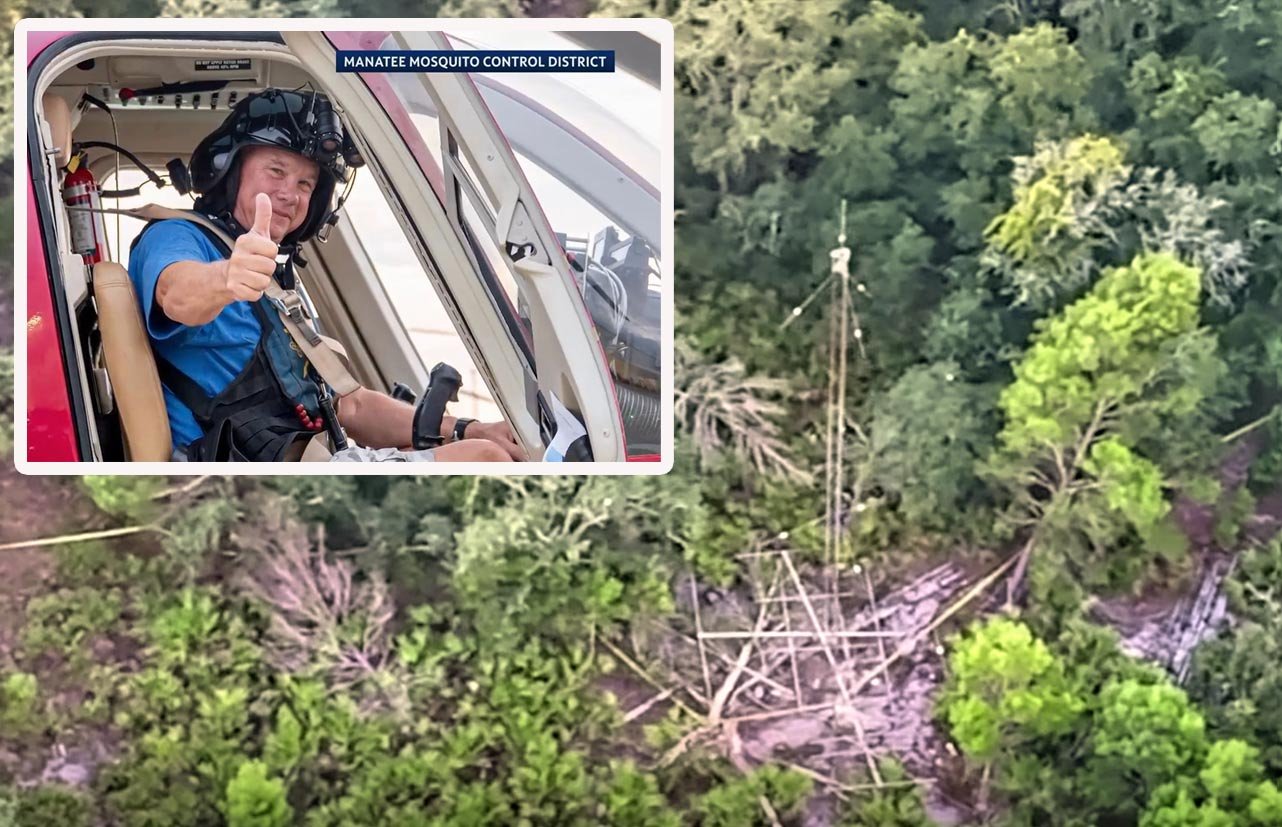
A Manatee County Mosquito Control District helicopter pilot, Isaac “Ike” Moore, 63, was killed at about 8:54 p.m. on Thursday, Oct. 15, when his Bell 407 crashed behind homes in the 10000 block of 289th Street East in Myakka City, FL, after striking what the Manatee County Sheriff’s Office described as a private radio tower. WirelessEstimator has determined that the towers at the site are amateur radio towers on property owned by Daniel E. Street, a licensed amateur radio operator who runs an amateur radio tower and antenna installation business from the same address.
Moore was the only person aboard. Residents near Dakin Dairy Farms pulled him from the wreckage before deputies, East Manatee Fire Rescue and Manatee County EMS arrived, and he was pronounced dead at the scene. The aircraft caught fire, and no one on the ground was hurt, WUSF reported.
Moore was on his first mission of the night and was heading back to Ellenton to reload and refuel for a second, NTSB air safety investigator Gene Rambo said at a Friday briefing. A second district helicopter spraying nearby saw the crash and landed safely. The district said Moore had more than 25 years of helicopter experience and about 10,000 flight hours, much of it with the Columbus, Ohio, Division of Police, which called him “an incredible officer, pilot and professional.”
Whose towers they were
Sheriff’s spokesman Randy Warren described the structure as “about a 150-foot private radio tower on private property.” At the same Friday briefing, an NTSB investigator said the property has three towers, reported to him as 50, 100 and 150 feet tall.
Manatee County property records show the parcel is owned by Daniel Street, and at least two towers are visible within the property boundary in publicly available street imagery. According to the FCC’s Universal Licensing System, Street holds an active amateur radio license, call sign K1TO. He also operates A1 Tower Service, a business specializing in amateur radio tower and antenna installation, from the same address. Street is a well-known figure in competitive amateur radio.
No lighting required
Warren said that, to his knowledge, “there are no lights on the tower” and that towers under 200 feet don’t have to be lit. Amateur radio towers below that height generally don’t need to be registered with the FCC’s Antenna Structure Registration system or marked and lit under FAA rules, unless they are close to an airport. Nothing in the public record suggests the towers on Street’s property were out of compliance.
A sub-200-foot structure in a rural area can be fully compliant with no federal registration and no lighting, in airspace where spray helicopters work at low altitude, at night.
Spray helicopters can legally fly low
Some individuals responding to the crash online have argued that the helicopter should not have been below 500 feet without an FAA waiver. The regulations are not that absolute. The FAA’s minimum-altitude rule, 14 CFR 91.119, lets helicopters fly below 500 feet when doing so creates no hazard to people or property on the ground, and Part 137, which governs aerial application, allows spray aircraft to fly below 500 feet and closer than 500 feet to structures during dispensing operations under the same condition. The Bell 407 is registered to the Manatee County Mosquito Control District as a government aircraft, not to a Part 135 charter operator. The FAA also warns pilots that many antenna towers at or below 200 feet are not marked, lit or charted as obstructions — which means a 150-foot amateur tower in a rural area would not necessarily appear on the charts a pilot reviews before a flight.
Investigators haven’t called it
The NTSB said it was still determining whether the helicopter struck a tower, though WWSB reported tower damage in the area. Drone video showed one structure broken in half. Investigators are examining human, mechanical, and environmental factors, including Moore’s medical and training records; the aircraft’s controls, transmission, and rotor system; weather and lighting conditions; and surveillance, drone, and FAA radar data. Helicopter and engine manufacturer representatives were expected to join the investigation.
“We don’t know why. We may never know,” Warren said, noting that spray crews “have to fly at a certain altitude and they’re making quick turns.”
The night flights were part of stepped-up spraying across the Tampa Bay region during Florida’s dengue outbreak, which had reached 368 locally acquired cases statewide through Oct. 10. The NTSB typically issues a preliminary report within about 30 days of a crash; a probable cause determination usually takes a year or more.